
After an incident in an industrial tank, utility vault, or processing vessel, investigators may have only a partial view of the work site. The opening is visible from outside, but the route to the work location may not be. Internal piping, ladders, partitions, and equipment can make even a short distance difficult to describe accurately. Before anyone tries to photograph the interior, the team has to address a more immediate question: can the space be approached or entered safely at all?
Reality capture can help document the physical arrangement of a space once the work is authorized and the selected equipment is suitable. This may involve photographs taken from an opening, a terrestrial scanner positioned in a safe location, or specialized remote inspection equipment. The useful outcome is not necessarily a complete 3D model. Sometimes the most important result is a well-documented access opening or a clear record of the area that could not be reached.
A confined space is not simply a small room
Under OSHA’s general industry standard, a confined space is large enough for a worker to enter and perform work, has limited or restricted entry or exit, and is not designed for continuous occupancy. Tanks, vessels, pits, and vaults can meet those criteria. A permit-required confined space has an additional serious or potential hazard, such as a hazardous atmosphere, engulfment, an entrapment configuration, or another recognized serious safety or health hazard (Occupational Safety and Health Administration, “1910.146”).
That distinction matters for documentation crews. A comfortable-looking equipment room does not automatically fall under the rule; a large vessel may. Construction work has its own confined spaces standard under 29 CFR Part 1926, Subpart AA. Applicable requirements depend on the activity and setting (Occupational Safety and Health Administration, “Confined Spaces in Construction”). A camera assignment does not change the space’s classification or the employer’s responsibility to assess its hazards.
Begin with the access points and the route inside
A useful record begins outside the space. Photograph the entry location relative to nearby equipment, work surfaces, and fixed structures. Record the size and visible configuration of the opening using an appropriate measuring method. Note the positions of ladders, steps, platforms, handholds, and any obstructions that affect movement into or out of the space. When there is more than one opening, identify each one clearly rather than relying on names such as “north hatch” without a site reference.

Inside an industrial vessel, the route may turn around baffles or pass through a series of compartments. Investigators may need to determine where a worker was assigned, which passages connected the work area to the exit, and whether fixed equipment narrowed those passages. A navigable model can illustrate the visible arrangement, but the underlying record should still include photographs, measurements, and a description of any missing areas.

Distances in these settings warrant particular care. The straight-line distance between a work area and an opening may differ substantially from the route a person could actually travel. Neither distance, standing alone, establishes the time required to exit or whether rescue could have succeeded. Such questions require a broader investigation.
What can be captured before anyone enters?
The first photographs may be taken from outside the opening. A camera or inspection device can sometimes reveal accessible interior surfaces without placing an operator inside. Whether that is feasible depends on the geometry, lighting, equipment reach, and the hazards at the location. An opening that provides a clear view in one direction may leave equipment and recesses completely hidden in another.
When entry is not authorized, it is better to document the available view and identify the limitations than to imply that the full interior was examined. A specialized remote system may be appropriate for some locations, but it must be evaluated for the environment. A conventional drone, consumer camera, or standard 3D scanner should not be assumed suitable for an atmosphere where flammable substances could be present. Equipment selection is both a safety and a documentation decision.
If entry later becomes permissible under the applicable program, the capture plan can be expanded. The photography or scanning team should operate within the established permit, isolation, monitoring, communication, and rescue arrangements. OSHA’s permit-space requirements address these controls; an attractive 3D deliverable is not a reason to bypass them (Occupational Safety and Health Administration, “1910.146”).
Choose the instrument around the question
Documenting a wide view of a tank interior and precisely measuring a ladder rung require different methods. Ground photography is often the clearest way to record labels, surface damage, connections, and other small details. A terrestrial scanner may be useful for more extensive interior geometry when access, visibility, and equipment conditions permit. A 360-degree walkthrough can show how areas connect, but the ability to navigate a model does not establish that its measurements meet a particular tolerance.
Reflective metal, standing water, dark surfaces, cramped corners, and repeated patterns can complicate optical capture. Pipes and structural members create occlusions that a scanner cannot penetrate. Multiple viewpoints may be needed, and some spaces may remain incomplete even after careful work. These are not merely processing problems. They affect what an investigator can reasonably conclude from the result.
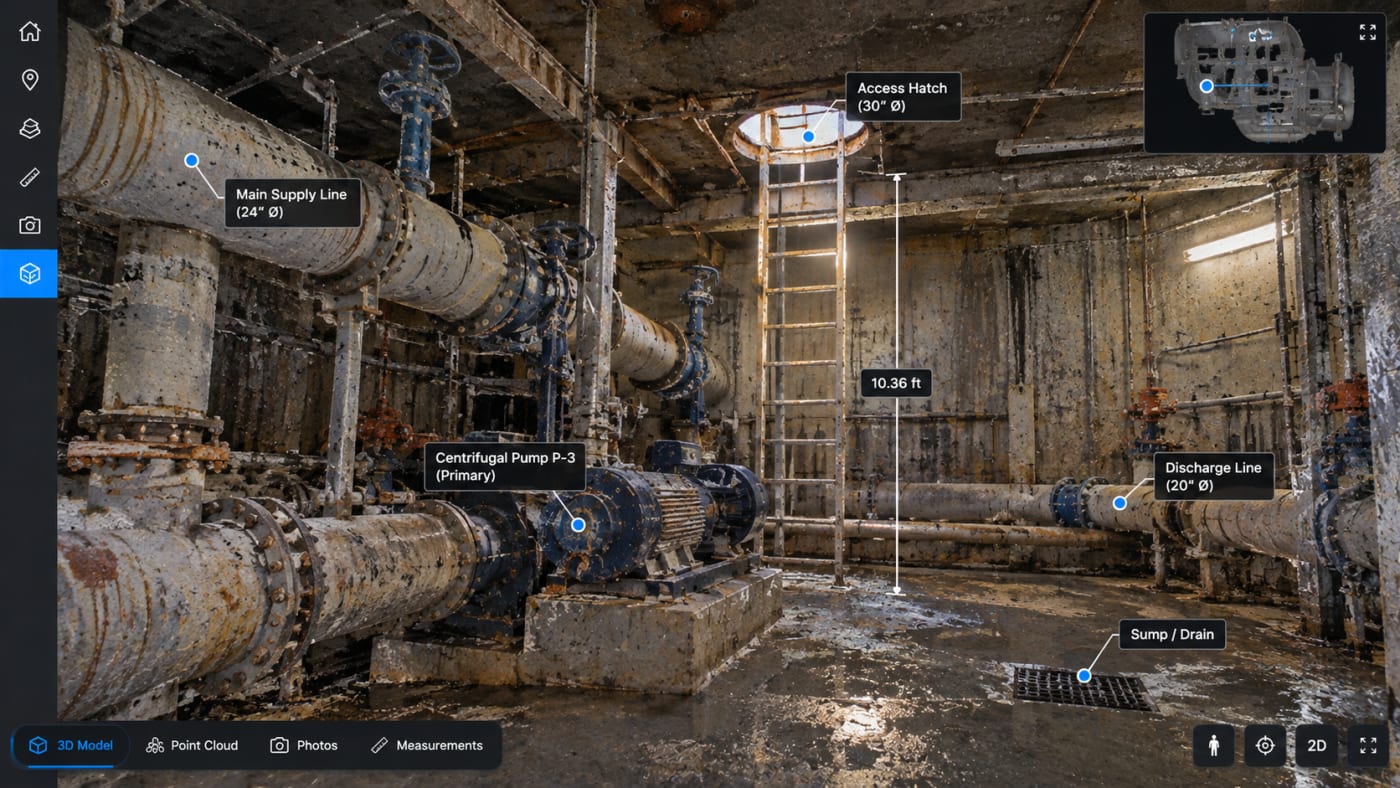
Before capture begins, the investigator and documentation operator should agree on the observations to be recorded. Is the task to record the position of a valve relative to a walkway? To establish the width of an opening? To show the route between a platform and a hatch? If a dimension may be used in engineering or forensic analysis, define the required accuracy and how the measurement will be verified. A visually convincing model is not a substitute for that step.
Separate the physical scene from the hazardous conditions
A scan can show a pipe, a ventilation duct, a drain, or a work platform. It cannot reveal the oxygen concentration at the time of an incident or determine whether a toxic gas was present. Nor can the appearance of a ventilation opening prove that effective airflow was present during the work. Atmospheric readings, instrument records, operating procedures, witness accounts, and other evidence may be needed to address those questions.
The same principle applies to a worker’s location. A model can record a vessel’s documented geometry, but it does not independently establish where a person was at a particular moment. If that location is inferred from testimony or other evidence, the article or investigative exhibit should state that. Physical documentation and incident reconstruction are related but not interchangeable tasks.
Keep the source record useful to the next reviewer
Confined-space imagery can be confusing when every frame looks like another section of the same pipe or wall. A practical delivery should identify the entry point, orientation, capture locations where known, the acquisition date, and the areas that were not documented. A simple location diagram can help readers connect detailed photographs to the larger interior. When a 3D model is provided, annotations should identify relevant features without covering or altering the original observations.
Original photographs and scan files should remain distinguishable from processed models and marked-up exhibits. If equipment was moved, the space was cleaned, or other changes occurred before capture, document what is known about those changes. For assignments involving litigation or sensitive operations, the parties should establish expectations for access, retention, and distribution before the files are circulated.
One useful practice is to pair each important spatial observation with its source. If an annotation identifies a ladder's location, provide the corresponding photograph or the viewpoint from which the scan was taken. If a measurement is called out, include the method and any verification record. That approach makes the documentation easier to assess without asking reviewers to accept the model based on appearance alone.
A limited record can still answer an important question
An incident site need not be scanned in its entirety to yield useful information. A properly documented hatch opening, an accessible portion of a tunnel, or a set of views showing internal obstructions may answer a specific investigative question. In other cases, the available access will not support meaningful 3D coverage, and that conclusion should be recorded plainly.
For SterFlies, confined-space documentation is best understood as a carefully planned field-recording service that supports qualified investigators. The investigator determines which physical information is relevant. The responsible site and entry personnel determine whether and how the work may proceed. The documentation operator selects an appropriate method and records what was actually observed. The resulting photographs, measurements, and spatial views can support technical review, but they do not replace hazard evaluation, testimony, testing, or professional judgment.
Works Cited
Occupational Safety and Health Administration. “1910.146: Permit Required Confined Spaces.” U.S. Department of Labor, https://www.osha.gov/laws-regs/regulations/standardnumber/1910/1910.146.
Occupational Safety and Health Administration. “Confined Spaces in Construction.” U.S. Department of Labor, https://www.osha.gov/laws-regs/regulations/standardnumber/1926/1926subpartAA.
Occupational Safety and Health Administration. “Confined Spaces.” U.S. Department of Labor, https://www.osha.gov/confined-spaces/.
Occupational Safety and Health Administration. “1926.1203: General Requirements.” U.S. Department of Labor, https://www.osha.gov/laws-regs/regulations/standardnumber/1926/1926.1203.