Service 01

Forensic Mapping & Site Documentation

Preserve changing site conditions through coordinated aerial, ground-based, and spatial documentation.

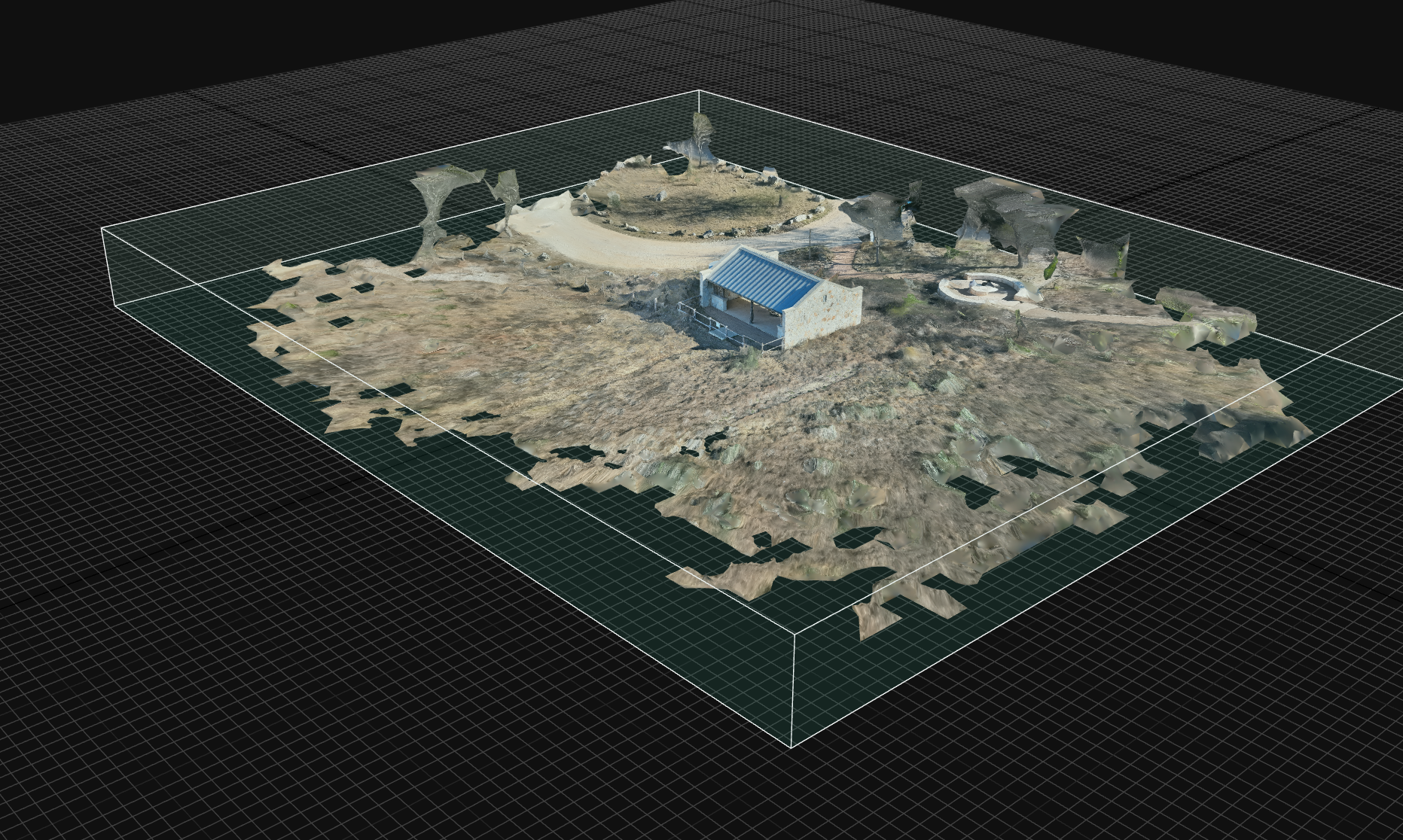
3D reconstruction of documented site conditions with a measurable bounding volume

Purpose

Why site documentation matters

Site conditions change. Equipment is moved, repairs begin, demolition proceeds, weather alters surfaces, temporary elements disappear, and access changes. Documentation preserves spatial context for later review after those conditions are no longer available on site.

Context

Why spatial context matters

A photograph records one viewpoint. An investigation, claim, or design review usually needs something else: how a location sat in relation to access, equipment, adjoining rooms, or the rest of the site. Once equipment is moved or a surface is repaired, that relationship is gone unless it was recorded as a spatial whole.

Forensic mapping exists to keep that whole available. SterFlies captures and organizes the record. It does not determine causation, responsibility, or the meaning of a condition. Those conclusions remain with the qualified professional reviewing the work.

Scope

What can be documented

Capture is selected for the site and the questions the record needs to support. The examples below reflect current field documentation work, not every possible environment.

  • Incident scenes

    Layout, access, and surrounding conditions before they are cleared.

  • Construction sites

    Progress, existing conditions, and staging as work advances.

  • Industrial facilities

    Yards, equipment surroundings, and operational context.

  • Excavations / trenches

    Open conditions that will be backfilled or altered.

  • Building exteriors

    Envelope, roof geometry, drainage, and access.

  • Interiors

    Room relationships, corridors, and close-range conditions.

  • Equipment surroundings

    Clearances, placement, and adjacent work areas.

  • IAQ / mold environments

    Interior layout and exterior context for sampling review.

  • Property conditions

    Existing-condition records for later comparison.

  • Infrastructure

    Site layout and surrounding conditions where access allows.

Methods

Aerial + ground-based capture

Aerial and terrestrial methods are complementary. Combined capture can preserve more complete site context than either method alone.

Aerial capture

  • Overall layout
  • Surrounding conditions
  • Top-down context
  • Difficult-access exterior areas

Ground / interior capture

  • Room relationships
  • Corridors and access routes
  • Equipment and close-range detail
  • Interior continuity

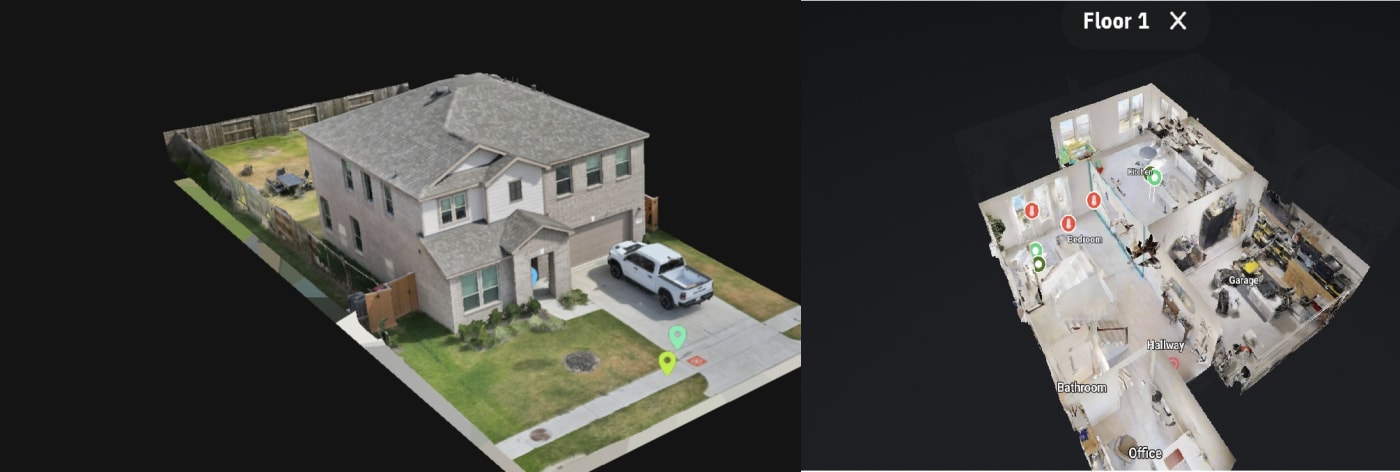
Interactive walkthroughs, including Matterport, are used when a navigable interior record is the appropriate deliverable. The IAQ project below shows how exterior reconstruction and interior capture can be paired.

Interior walkthrough with exterior 3D context

Deliverables

Records selected for the engagement

  • Orthomosaic

    Scaled aerial map of site layout, access, and surrounding conditions.

  • 3D model

    Navigable geometry for remote review after conditions have changed.

  • Point cloud

    Spatial dataset that can support measurement and further analysis.

  • High-resolution site imagery

    Still photography for conditions, access, and visual reference.

  • Matterport / interactive walkthrough

    Interior tour that preserves room layout and annotated locations.

  • Measurements

    Distances, areas, or volumes derived from the agreed capture scope.

  • Annotated imagery

    Marked stills that connect observations to a location in the record.

  • Supporting files

    Organized exports as specified for the engagement.

Deliverables are selected according to project scope, site conditions, and documentation objectives.

Measurement

Measurement considerations

Distances, areas, and volumes can be taken from an orthomosaic, point cloud, or model when the capture was planned for measurement. Overlap, surface texture, occlusions, and any control used for the engagement all affect what can be measured later. A number from the model should be read with that method in mind.

Photogrammetric measurement is not a licensed land survey, an as-built certification, or a stamped engineering product. When a project requires a surveyor, engineer, or other licensed measurement, that work stays with the licensed professional. The SterFlies record can still provide context around it.

Field conditions

Working around site constraints

Sites limit what can be captured. Active work, restricted airspace, weather, interior lighting, reflective surfaces, and access controls all change the plan. The useful response is to state what was reachable and what was not, then choose a method that still preserves the conditions the review needs.

Aerial coverage is often the right overview and the wrong interior record. Ground-based capture is often the right room record and the wrong site map. Combining them is a scope decision, not a default package. Flight limits, scan line of sight, and safety requirements are planned before capture, not repaired afterward.

Applications

Professional applications

SterFlies produces the record. Qualified professionals interpret that record.

  • Incident investigation

    Preserve scene layout and surrounding conditions for later review.

  • Construction / defect documentation

    Record existing conditions before they are covered or altered.

  • Industrial hygiene / IAQ

    Connect interior sampling context with exterior building conditions.

  • Insurance / property loss

    Document conditions that support later claims review.

  • Expert review

    Provide spatial context that photographs alone often cannot reconstruct.

  • Construction safety

    Preserve access, staging, and site layout for later analysis.

  • Facility documentation

    Create a reviewable record of current building and site conditions.

Applications

How the record is used

Incident and investigation work uses the record to preserve layout, access, and surrounding conditions before a scene is cleared. Construction and industrial work uses it to keep exposed conditions, staging, and site layout available after they are covered or changed. Industrial hygiene and IAQ work uses interior continuity and exterior context so later sampling review can be located in the building, without SterFlies performing the assessment.

In each case the documentation supports someone else’s professional judgment. Expert, insurance, and facility reviewers can use the spatial record when photographs and notes no longer reconstruct the site. The record does not replace that review.

Workflow

A documentation workflow

  1. 01

    Define documentation objective

    Identify what conditions need to be preserved, measured, or reviewed.

  2. 02

    Review access and site conditions

    Determine what can be captured safely from the air and on the ground.

  3. 03

    Select capture methods

    Choose aerial, terrestrial, thermal, or combined methods for the required record.

  4. 04

    Document the site

    Capture field conditions systematically.

  5. 05

    Process and organize data

    Create the agreed spatial, visual, and supporting deliverables.

  6. 06

    Deliver records for review

    Provide organized documentation for project teams and qualified professionals.

SterFlies captures and organizes field conditions. Interpretation of those conditions remains with the appropriate qualified professional.

Limits

Professional interpretation and limitations

The practice preserves visible and spatial conditions. It does not determine accident causation, mold or IAQ conclusions, code compliance, structural adequacy, or legal responsibility. Annotations mark locations. They do not validate laboratory results or opinions placed beside them.

Operational work is conducted under an FAA Part 107 remote pilot certificate where aircraft are used, with OSHA 10 construction safety training and insured operations. Those credentials support field access and flight operations. They are not industrial-hygiene, engineering, or surveying licenses.

Project

Selected field documentation

An example of combined interior and exterior documentation. Results are limited to what was captured and delivered.

Combined interior and exterior 3D documentation of existing site conditions

Interior and exterior documentation

IAQ & Mold Existing Conditions Documentation

What was documented
Interior walkthrough and exterior 3D model of existing building conditions.
Capture methods
Ground-based interior capture paired with exterior photogrammetric reconstruction.
Why it mattered
Preserve room layout, sampling context, and envelope conditions for later professional review.
Deliverables
Interior walkthrough, exterior model, and annotated views.
View project

Need a site documented?

Tell us what needs to be captured, measured, or preserved and we can determine the appropriate documentation approach.