
An industrial exposure investigation can hinge on a surprisingly simple question: where was the person standing? A worker may describe being near a tank, behind equipment, or along a platform when a release allegedly occurred. Months later, those descriptions can be difficult to reconcile with a floor plan or a handful of photographs. The equipment is still there, but the site may have been modified, cleaned, or rearranged.
A 3D scan cannot establish that a chemical reached a person. What it can do is preserve the visible arrangement of a work area and provide investigators with a shared reference for examining reported positions, access routes, equipment geometry, and distances. Used carefully, that record helps separate questions about location from those about exposure.
For industrial hygienists and forensic consultants, the distinction matters. OSHA directs exposure evaluators to consider the processes involved, employee movement, ventilation, and distance from potential sources, among other factors (Occupational Safety and Health Administration, “OSHA Technical Manual”). A map can clarify some of those spatial factors, but it does not supply the missing air sample.
Start With the Question, Not the Scanner
Before a scanning crew enters an industrial facility, the requesting investigator should determine what the spatial record must address. Is the issue the straight-line distance between a reported work position and a tank? The route to a platform? Whether a wall separates two work areas? Or the location of a sampling point relative to equipment?
Each question requires a slightly different capture plan. A broad, navigable walkthrough can document relationships between adjacent rooms and corridors. Close-up views and carefully selected scan positions may be needed around valves, openings, vessel connections, and structures that obstruct the camera. If a particular dimension is central to a technical opinion, the required accuracy should be established before fieldwork, not after the scan has been processed.

The request should also distinguish known facts from disputed positions. A scanner records a location; it does not confirm that a person occupied that location during a past event. The reported worker position may come from testimony, an interview, a work record, or another source and should be identified accordingly.
Document the Reported Work Position and the Suspected Source
Consider a hypothetical processing area with a storage tank, attached piping, a maintenance platform, and a corridor. A worker reports performing a task near the platform while a chemical release may have originated at a connection on the tank. The investigation team seeks to understand the physical relationship among these locations.
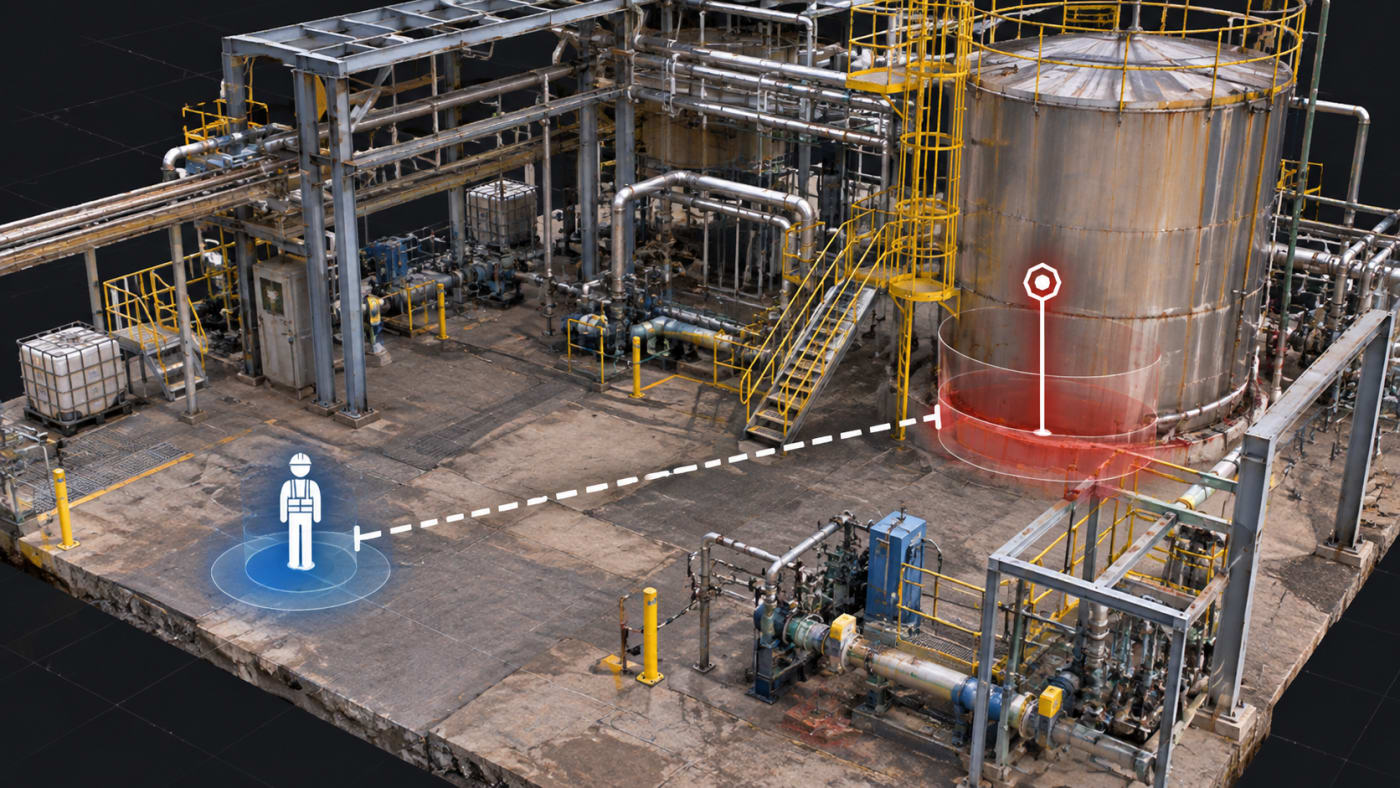
A useful 3D record would include the tank body, visible connection points, nearby structural members, the platform and its access points, and surrounding equipment. Ground photographs should supplement the scan with close-up views of component labels, valves, gauges, and other details that may not resolve clearly in a model.
If the worker position and release point are drawn from different evidence sources, mark them separately. A label such as “reported worker location, based on interview” is more defensible than a marker simply labeled “exposure location.” The latter implies a conclusion that the geometry alone cannot support.
The same caution applies to the suspected source. An apparent nozzle or flange in a model can be accurately located without confirming that a release occurred there. That determination belongs to the professionals who evaluate equipment, process history and the available physical evidence.
The Distance Question Has More Than One Answer
A model can support several distance-related questions. The horizontal distance between two floor positions is not the same as the three-dimensional straight-line distance between a worker’s location on a platform and a connection lower on a tank. Neither describes the route of an airborne contaminant.
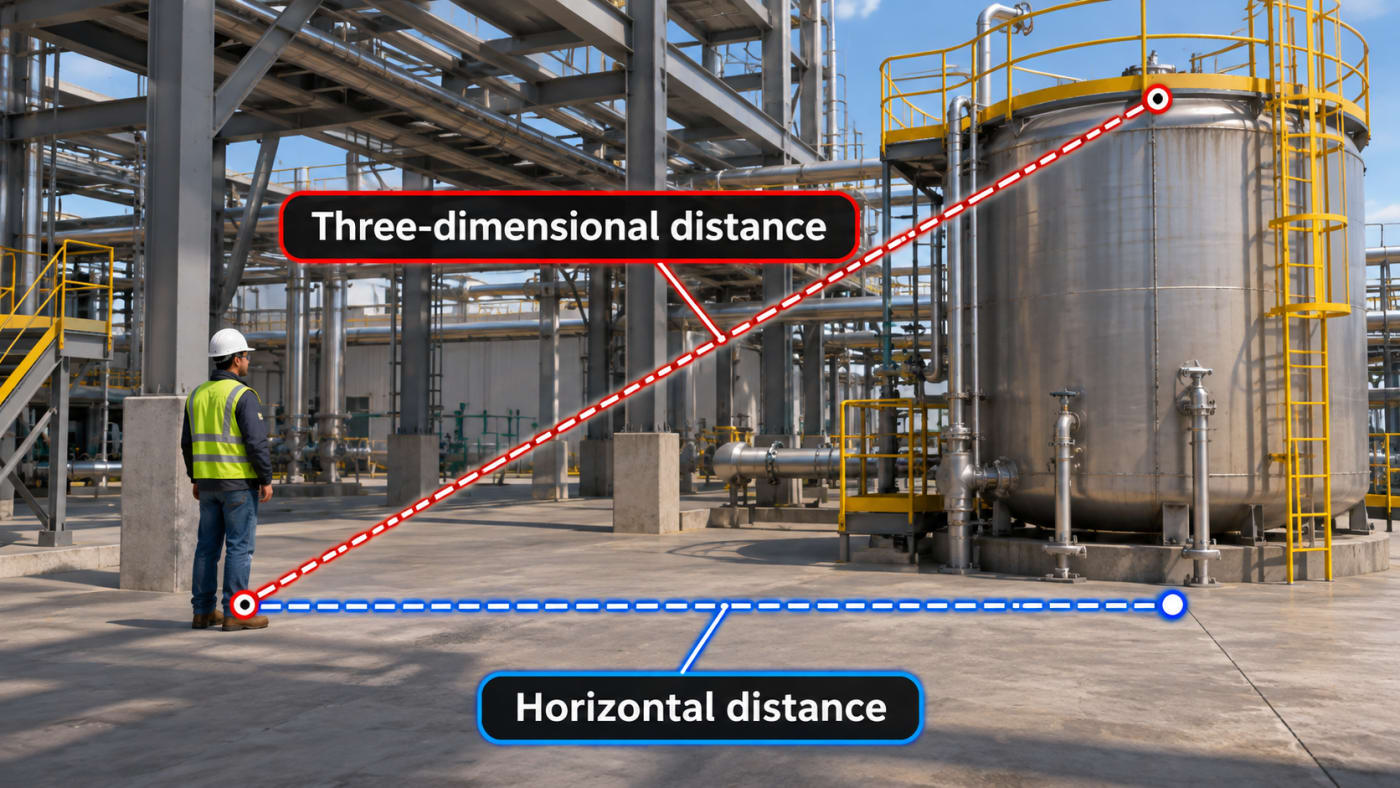
Suppose a proposed point of release is 12 feet from a marked worker position in plan view, while the worker position is 8 feet higher. The straight-line separation is about 14.4 feet. These figures are hypothetical, not from a specific case. Their purpose is to illustrate why an investigator should specify which two points are being measured and what type of distance is being reported.
For work areas divided by barriers, investigators may also examine the walking route between locations, a doorway opening, or a route through a service corridor. These measurements help explain site layout and movement. They should not be converted into an estimate of dose or airborne concentration without a separate, scientifically appropriate analysis.
Matterport provides measurement tools within its digital spaces, but the output remains subject to capture and processing limitations (Matterport, “Take Measurements”). The Pro3 camera manufacturer reports a raw depth accuracy of approximately plus or minus 20 millimeters at 10 meters under stated conditions; that specification is not a blanket guarantee of the accuracy of any completed multi-scan model (Matterport, “Pro3 3D Camera”). For important dimensions, the project team should establish tolerances and consider independent field verification.
Walls, Platforms and Equipment Change the Spatial Picture
Two people can be close together in plan view yet be separated by equipment, elevation differences, or a wall. A tank may have a surrounding catwalk. A process line may pass behind a partial enclosure. A worker may have used one staircase rather than another.
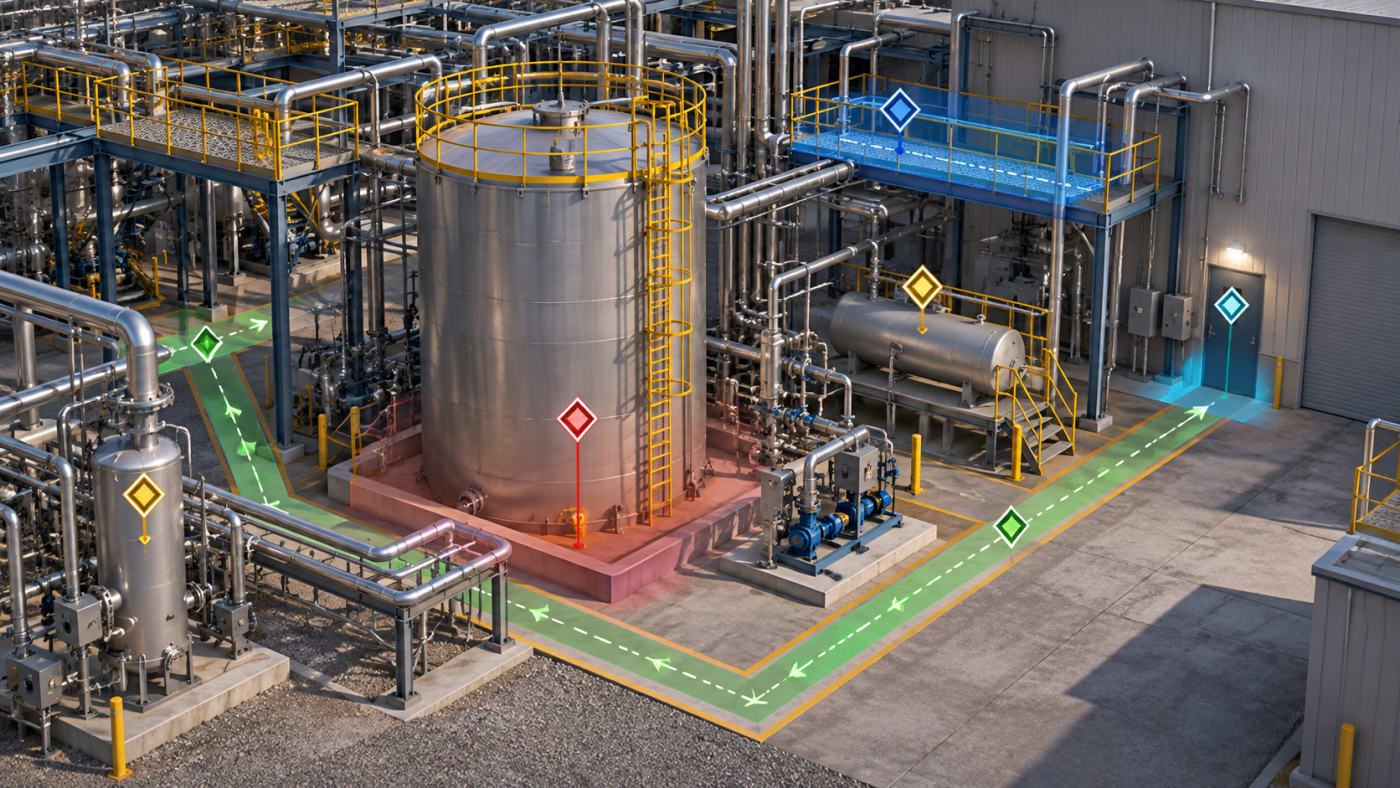
Those features are worth documenting because they help the reviewer understand the physical environment where the work was performed. An investigator comparing statements can revisit the same geometry rather than relying on memory of a site visit. An annotated model may also make it easier to explain which features were present when the scan was collected.
But a barrier visible in a scan is not automatically a vapor barrier. Openings, ventilation systems, pressure differences, and operating conditions affect airborne transport. A model can locate an exhaust hood or a door; it cannot show whether the hood was operating or the direction of air movement during a past release. OSHA identifies ventilation and employee work practices as important parts of exposure evaluation, and those matters require additional evidence (Occupational Safety and Health Administration, “Sampling”).
Capture Conditions Can Affect the Record
Industrial spaces are not simple rooms. Pipe racks obscure surfaces. Polished metal reflects light. Similar-looking machinery repeats along long corridors. A large tank may block the view of equipment behind it. Moving workers, vehicles, and temporary materials can complicate capture.
The field operator should work through the investigator’s priority locations, review scan coverage before leaving, and take photographs where geometry is incomplete or markings are difficult to read. For a technical request involving a particular flange or access opening, those details should be visible in more than one supporting image, when practical.
Capture may be incomplete for legitimate reasons. A hazardous atmosphere, an active process, a restricted work area, or an unstable structure may prevent entry. Commercial scanning equipment must not be assumed suitable for flammable or otherwise hazardous atmospheres. Site access and equipment suitability require appropriate hazard assessment and authorization. Document the restriction rather than quietly presenting an incomplete model as complete.
A spatial record also includes a date. A scan performed after piping has been replaced may not reflect the arrangement at the time of the alleged exposure. Report subsequent modifications as limitations and use historical drawings, photographs, and records where available.
Connect the Geometry to the Other Evidence
The scan becomes more useful when people can tell where its observations came from. A marked point associated with a worker interview should include the interview reference. A valve identified in a model should be cross-checked against equipment records. A sampling location should be tied to a sample identifier, date, and method rather than left as an unexplained pin.
A practical deliverable might include an overall 3D walkthrough, selected annotated views, a measurement log, conventional photographs, and a brief description of capture limitations. The measurement log can list the point labels, indicate whether the reported distance is horizontal or three-dimensional, specify the units, and describe the verification method. If measurements were not independently verified, state that plainly.
Original files and unannotated exports should be retained in accordance with project requirements. Annotations are interpretations or organizational aids layered over the underlying capture. They should remain distinguishable from the original documentation, especially if the material may later be reviewed in litigation.
Why the Scan Cannot Determine Chemical Exposure
A common mistake is to treat distance as a direct measure of exposure. It is not. A worker 10 feet from a source is not necessarily more exposed than someone 20 feet away. The chemical, release rate, duration, work task, air movement, engineering controls, breathing-zone conditions, and route of contact can change that relationship.
OSHA’s sampling guidance calls for evaluating the chemicals and operations involved, identifying potentially exposed workers, and selecting appropriate sampling methods (Occupational Safety and Health Administration, “OSHA Technical Manual”). In its respiratory protection guidance, OSHA describes personal exposure monitoring as a primary method for assessing employee exposure and notes that predictive estimates require inputs such as room dimensions, air exchange, release rate, and work patterns (Occupational Safety and Health Administration, “Respirator Selection”).
The chemical may also pose dermal or other exposure risks. A scan does not identify an unknown substance, characterize its concentration, establish skin contact, or demonstrate a medical consequence. Industrial hygiene conclusions must be based on appropriate measurements, records, and professional analysis.
Spear and Lancaster’s published discussion of exposure assessments similarly emphasizes understanding tasks, work practices, and the sampling strategy rather than relying on a single observation (Spear and Lancaster, “Industrial Hygiene Exposure Assessments”). Reality capture can provide spatial context for that work, but the disciplines remain distinct.
A Short Hypothetical Example of a Useful Deliverable
Assume an investigator has two conflicting accounts of where a technician worked near a process tank. One account places the technician at the base of the vessel; another places the technician on a platform several feet above it. The technician’s exact position at the time of an alleged event is disputed.
A scanning team documents the accessible tank area and produces a navigable model. The investigator marks the two reported positions with distinct labels, selects the visible tank connection of interest, and requests separate measurements from each position. Photographs identify the ladder, platform railing, adjacent process piping, and the connection.
The resulting record does not determine which account is correct. It provides the parties with a shared view of the geometry and makes the differences between the two descriptions tangible. The investigator can see which distances are being discussed and what equipment is involved. If the scan was taken after an equipment change, that limitation is documented alongside the images.
The final question, whether a chemical release caused an occupational exposure, still requires independent evaluation. That is precisely why a focused spatial record can be useful: it answers the geometry question without pretending to answer all the others.
A Better Way to Brief the Documentation Team
The best assignment descriptions are specific. Instead of requesting “a 3D scan of the chemical area,” the investigator can specify the process equipment, reported work locations, height differences, relevant access routes, suspected source components, and the required level of dimensional confidence. The scanning team can then plan viewpoints and supporting photographs around those objectives.
Before leaving the site, the operator should confirm that the specified locations are captured, the relevant equipment labels are legible, restricted areas are documented, and any critical measurements are addressed using an appropriate method. After delivery, the investigator should be able to trace an annotated point back to the evidence used to define it.
SterFlies provides interior reality capture, aerial mapping, and supporting site photography to document physical conditions for subsequent professional review. In a chemical exposure investigation, SterFlies’ role is to create a clear spatial record of observable conditions. Exposure reconstruction, health interpretation, and causation conclusions remain the responsibility of qualified professionals working with the full evidence.
Works Cited
Matterport. “Pro3 3D Camera for Scanning and Virtual Tours.” Matterport, https://matterport.com/pro3.
Matterport. “Take Measurements of Your Spaces.” Matterport Support, https://support.matterport.com/s/article/Introducing-Measurement-Mode-Now-Everyone-Can-Measure?language=en_US.
Occupational Safety and Health Administration. “OSHA Technical Manual, Section II, Chapter 1: Personal Sampling for Air Contaminants.” U.S. Department of Labor, https://www.osha.gov/otm/section-2-health-hazards/chapter-1.
Occupational Safety and Health Administration. “Respirator Selection.” Respiratory Protection eTool, U.S. Department of Labor, https://www.osha.gov/etools/respiratory-protection/respirator-selection.
Occupational Safety and Health Administration. “Sampling.” Sampling and Analysis, U.S. Department of Labor, https://www.osha.gov/sampling-analysis/sampling.
Spear and Lancaster. “Industrial Hygiene Exposure Assessments: Worst-Case vs. Random Sampling.” Spear and Lancaster, https://jespear.com/industrial-hygiene-exposure-assessments-worst-case-vs-random-sampling/.